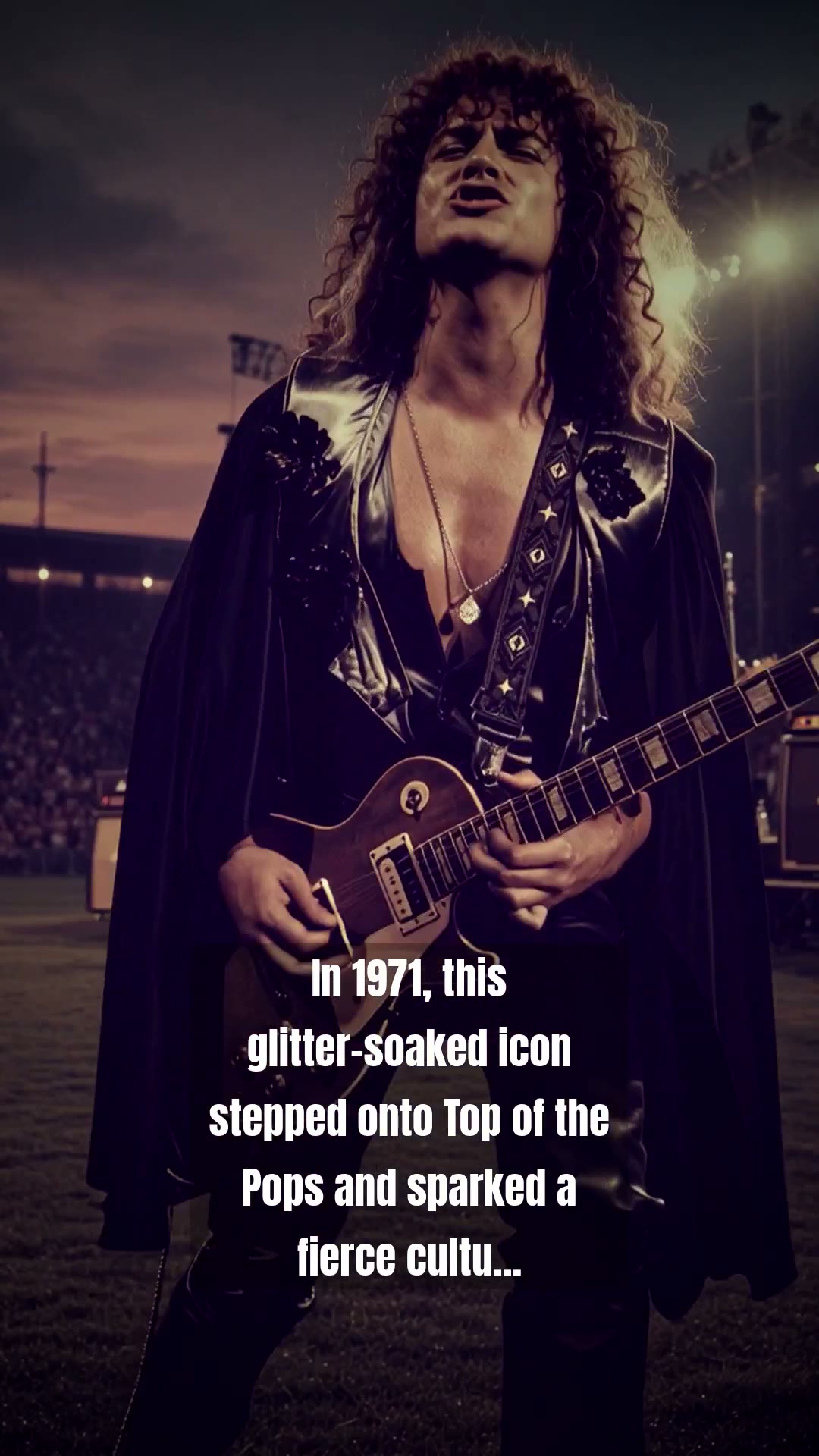
Cast your mind back to a chilly Thursday evening in March 1971. The nation was huddled around the telly, waiting for the weekly dose of Top of the Pops. We were all accustomed to the polished, safe sounds of the era, but then, something utterly alien flickered into our living rooms. Marc Bolan, draped in glitter and looking like he had stepped off a spaceship rather than out of a London bedsit, stood centre stage. With a stroke of his guitar and a sprinkle of stardust, he didn’t just perform a song; he sparked a cultural revolution that changed the course of British music forever.
That night, when Marc Bolan appeared with T. Rex to perform ‘Hot Love’, he was not merely a pop star; he was an apparition. For those of us watching in our living rooms, it felt as though the grey, post-war gloom of the late sixties had suddenly been washed away by a riot of colour. He had painted stars on his cheeks, donned satin, and exuded an androgynous swagger that made our parents clutch their tea cups in bewilderment. It was the birth of glam rock, a moment so electric it felt like the very fabric of British society was shifting under our feet.
Before that pivotal appearance, Bolan had spent years honing his craft, transitioning from the folk-infused psychedelia of Tyrannosaurus Rex to the electrifying stomp of T. Rex. He had the charisma of a street-smart poet and the ambition of a stadium filler. When he realised that the public was hungry for escapism, he provided it in spades. The sheer audacity of his look—the feathers, the sequins, the glitter—was a bold two-finger salute to the dullness of the everyday. It gave every teenager in the country permission to be someone else, to be vibrant, and to be absolutely fabulous.
Behind the scenes, the scene was far more chaotic than the polished broadcast suggested. The rise of Marc Bolan created a frenzy that pre-dated the hysteria of later pop movements. Journalists from the NME scrambled to capture the man who seemed to have invented a new way to exist. Yet, despite the massive fame, there was a fragile, human side to the glitter. Bolan was a working-class lad from Hackney who had dreamt of stardom and, by sheer force of will, managed to drag it into reality. He was the original glam pioneer, the man who proved that music didn’t have to be a sermon; it could be a party.
Even now, decades after his tragic and untimely passing, the influence of Marc Bolan remains etched into the DNA of British rock. Whenever we hear those signature fuzzy guitar riffs or see the legacy of his flamboyant style reflected in modern bands, we are reminded of that night in 1971. He taught us that music is at its best when it is daring, theatrical, and slightly dangerous. Do you remember where you were when the glitter first hit the screen? It remains one of those rare, golden moments that, once witnessed, you simply never forget.