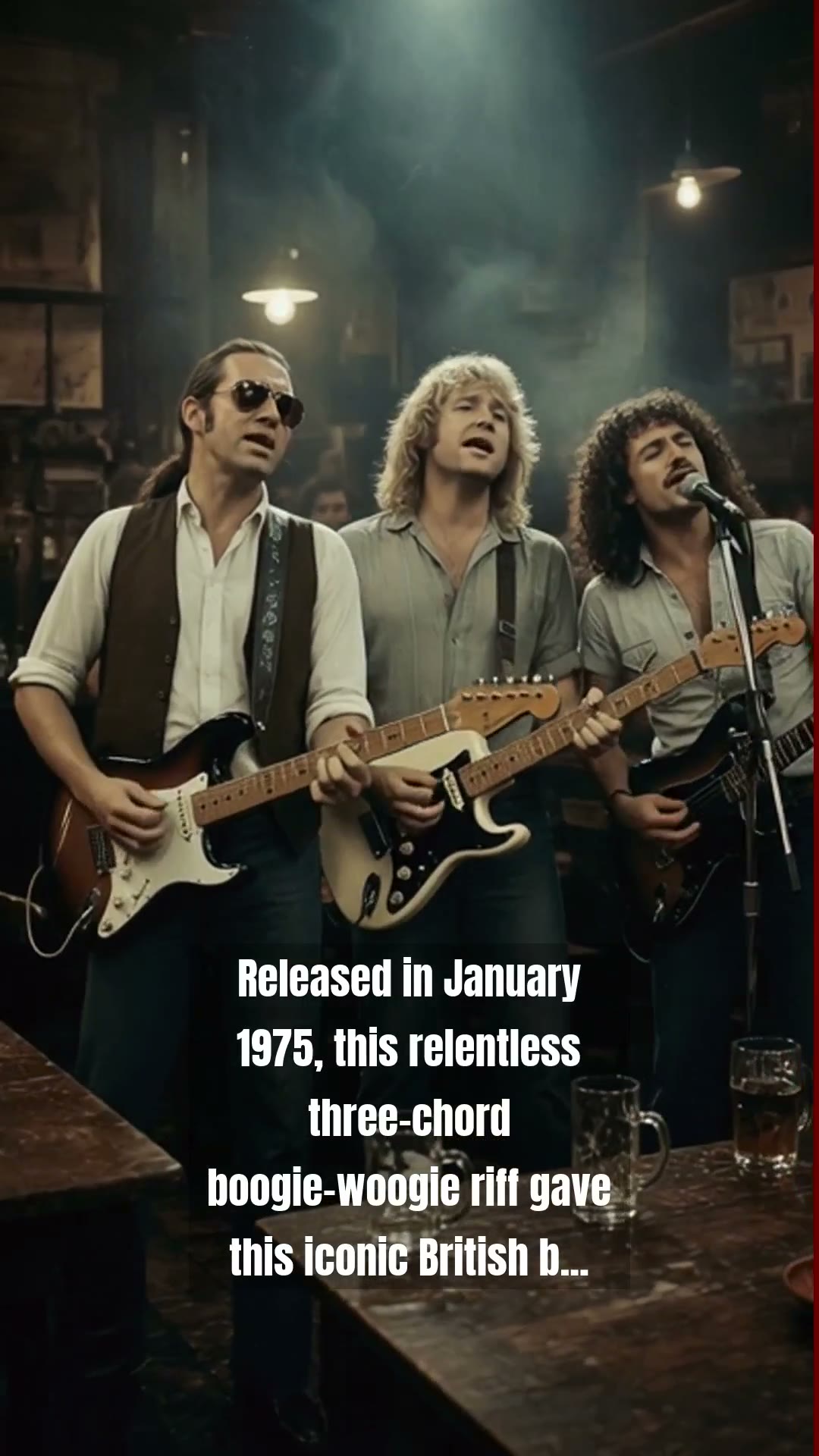
It was January 1975, a grey and bitter British winter, when a relentless three-chord boogie-woogie riff began to shake every pub and council house up and down the country. For a band that had spent years carving out a reputation in the sweaty, beer-stained clubs of the London circuit, this was the moment everything changed. Status Quo, the quintessential working-class heroes of rock, finally struck gold. Down Down hit the top spot of the UK Singles Chart, becoming their first and only number-one hit, and in doing so, it cemented their place in the heart of the British public for decades to come.
To realise the impact of this song, you have to remember the landscape of the mid-seventies. While prog-rock was busy getting lost in its own complexity and glam rock was painting its face in vibrant colour, Status Quo took a different approach. They were stripped-back, honest, and gloriously simple. Francis Rossi and Rick Parfitt were the quintessential double-act, two blokes with Telecasters who understood that you didn’t need a thousand notes to move a crowd—you just needed one cracking rhythm. They brought a sense of no-nonsense grit that resonated with anyone who’d ever had a long week at the factory or the office.
The story behind the success of Down Down is one of sheer persistence. Before they became the denim-clad legends we recognise today, Status Quo had flirted with psychedelic pop and varied experiments, but they eventually found their spiritual home in the high-octane boogie that defined their peak years. When they unleashed that riff, it wasn’t just a track; it was a phenomenon. You couldn’t turn on the telly or catch a show on Radio 1 without hearing it. It became the soundtrack to a thousand Friday nights, a song that demanded you tap your foot even if you were nursing a lukewarm pint in a quiet local.
There is something profoundly nostalgic about the sound of Status Quo during this era. They were the favourite band of the bloke next door, the ones who could pack out a gig at the Hammersmith Odeon as easily as they could fill a village hall. They didn’t rely on theatrical masks or bizarre costumes; they relied on that relentless, driving tempo that made it impossible to stand still. It was music that captured the spirit of a Britain that was ready to shake off the winter gloom, even if only for the three minutes and forty-nine seconds the single lasted.
Decades later, the song still carries that same punch. Whenever you hear the opening notes of Down Down, you are instantly transported back to a time of platform shoes, flared trousers, and that uniquely British camaraderie found in a crowded pub. Status Quo never tried to be clever; they simply aimed to entertain, and that is precisely why they remain an enduring part of our musical heritage. It is a reminder that sometimes, the simplest ideas are the ones that endure the longest. If you ever find yourself needing a bit of a lift, look no further than this classic, because that boogie-woogie beat truly never gets old.