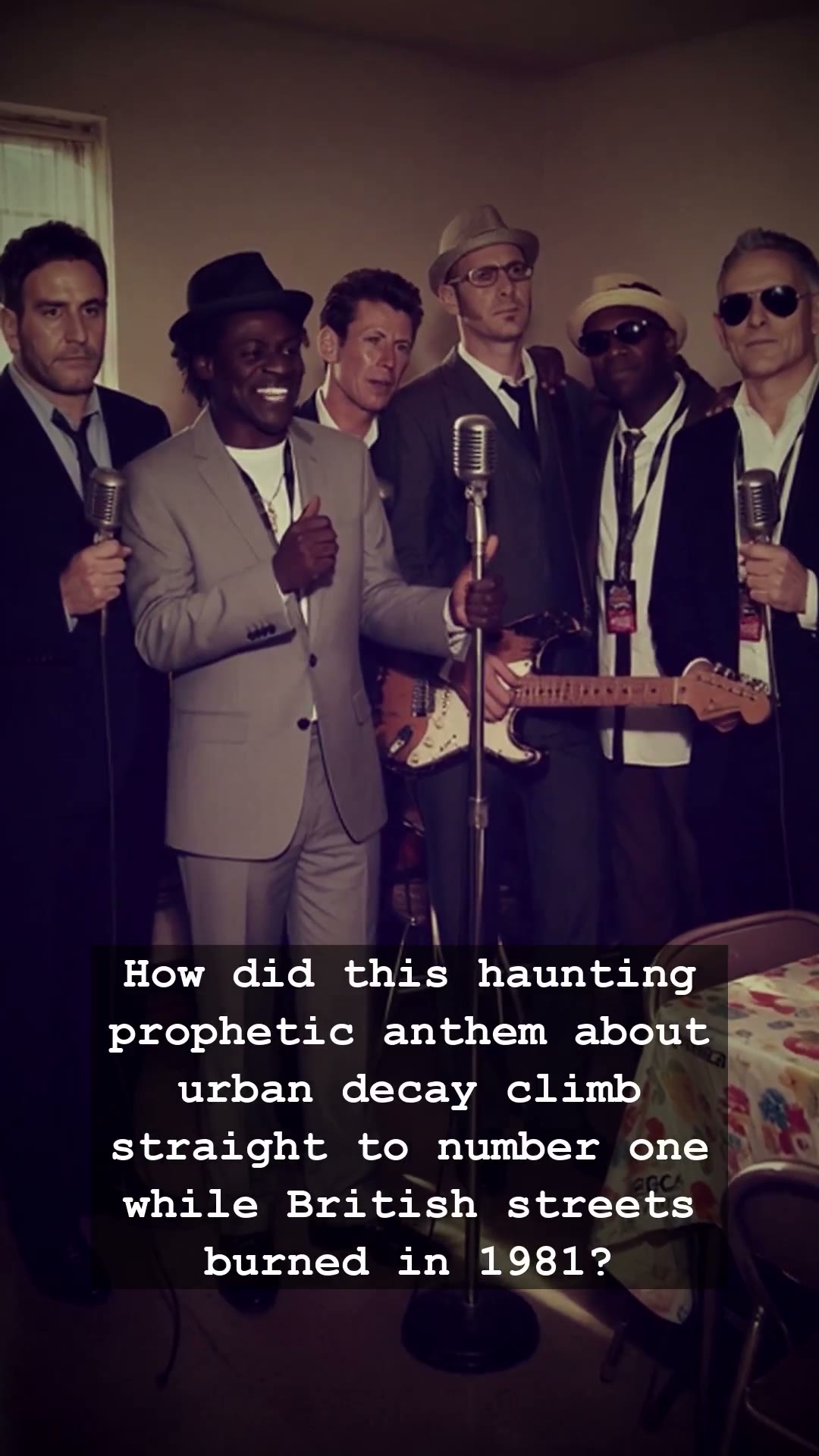
Picture the scene. It is the scorching summer of 1981, and the television news is a relentless loop of grey concrete, billowing smoke, and shattered glass. British streets are burning with riots, fuelled by economic despair, high unemployment, and crushing racial tension. Yet, echoing from transistor radios up and down the country is a track that feels less like pop music and more like a dispatch from the front line. That track was Ghost Town by The Specials, a haunting, prophetic masterpiece of urban decay that somehow clawed its way straight to number one on the UK charts just as the nation seemed to be tearing itself apart.
Formed in Coventry by songwriter and keyboardist Jerry Dammers, The Specials were the architects of the 2-tone movement. They fused the infectious, upbeat rhythms of Jamaican ska with the sharp, cynical bite of British punk. By 1981, however, the joyous energy of their early singles had curdled into something much darker. The band itself was fracturing under the immense pressure of touring, artistic differences, and exhaustion. When they went into the studio to record what would be their swansong, the atmosphere was suffocating. They did not just write a song about urban decay; they captured the dying breath of post-industrial Britain.
With its ghostly vocal harmonies, eerie brass stabs, and a languid, trudging beat, Ghost Town felt entirely out of step with the bubbly synth-pop dominating the telly on Top of the Pops. And yet, it resonated instantly with a generation that felt entirely forgotten. The lyrics spoke of closed-down mills, boarded-up pubs, and the creeping dread of youth with absolutely nowhere to go. It was a bleak reflection of Thatcher’s Britain, capturing a grim reality where people felt trapped in concrete labyrinths. When it hit the top spot in July 1981, it felt like an eerie cultural prophecy delivered right when the country needed to hear it most.
The irony was not lost on anyone that the band split up for good almost immediately after the single was released. Terry Hall, Lynval Golding, and Neville Staple walked away to form Fun Boy Three, leaving Dammers behind with his bleak masterpiece. They had captured lightning in a bottle, but the friction required to create that spark had burned them out completely. It was a classic British pop tragedy—brilliant, fleeting, and steeped in melancholy.
Decades later, Ghost Town remains one of the most important singles in British music history. It is a chilling audio time capsule of a fractured nation, reminding us of a time when cities felt like powder kegs waiting to blow. Whenever you hear those opening notes, you are instantly transported back to a turbulent summer of discontent, proving that the best music does not just entertain us—it bears witness to our history.